Choosing the best International Travel Adapter from China is not simply a matter of finding the smallest plug or lowest price. Travelers need a product that matches destination sockets, supports their devices’ voltage requirements, and feels dependable after repeated use. Small details matter: a loose-fitting plug, unclear power rating, or bulky body can become frustrating beside a crowded hotel bedside table.
The travel market is substantial. UN Tourism’s January 2025 World Tourism Barometer estimated 1.4 billion international tourist arrivals in 2024, about 99% of 2019 levels. IATA also reported that global passenger demand rose 10.4% in 2024 compared with 2023. These figures describe travel activity, not adapter sales, but they show why reliable charging equipment matters to people crossing borders. Still, no industry report can identify one universally “best” adapter for every traveler.
A useful comparison should examine supported plug types, USB output, total wattage, build quality, safety features, and transparent product documentation. It should also separate a travel adapter from a voltage converter: an adapter changes plug shape, but does not necessarily change electrical voltage. That distinction is easy to miss. Products made in China vary widely, so country of origin alone is not proof of quality. Look for clear specifications and independently verifiable testing information, then check device labels before packing. The best choice is the one that suits your route and electronics—not the one with the most ports. Real-world testing can reveal issues that a product page cannot.
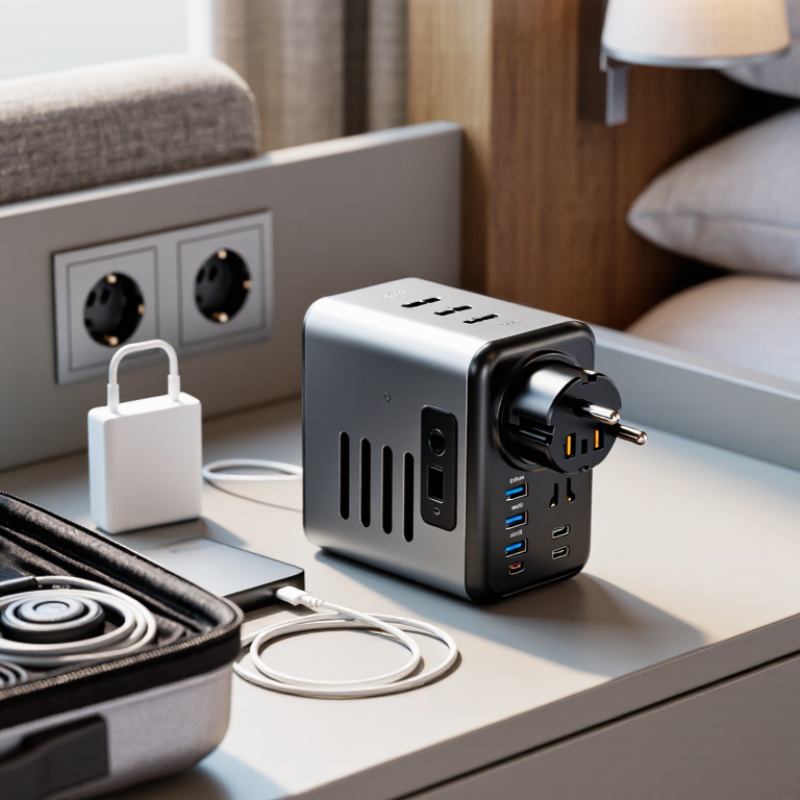
A travel adapter should match the sockets you will actually use, not just promise worldwide coverage. Check the plug shape for each destination: Type C may fit some European outlets, while the United Kingdom commonly uses Type G. Socket standards can vary within a region, so confirm before packing. A compact adapter is easier to carry, but its printed rating and grounding support matter more than its size.
Read the input label on each device’s charger. If it states 100–240 V, 50/60 Hz, it is designed to accept a broad range of mains voltages; the adapter only changes the plug connection. That distinction is easy to miss. A hair dryer marked 120 V only may not work safely on a 230 V supply with a simple travel adapter. Voltage converters have wattage limits, add weight, and may not suit motors or heating elements. Check the appliance manual and converter rating together.
For a phone or laptop, a properly rated adapter is often enough when the charger supports 100–240 V. For grounded equipment, choose an adapter that preserves the earth connection; a two-pin design cannot do that. Look for clear ratings, secure plug fit, and protection against overload.
One detail still deserves a second look: a plug that fits does not prove the voltage is compatible.
Choose an adapter by the socket at your destination, not by a vague “universal” label. A practical guide groups common sockets into four families: A/B, C/E/F, G, and I. Type A/B sockets use flat pins, while C/E/F sockets generally take round-pin plugs.
Type G sockets, common in the United Kingdom and several other destinations, use three rectangular pins. Type I sockets, used in Australia and New Zealand, have angled flat pins; they are also common in China.
Socket shapes can vary within a country, so check the exact destination and lodging. I would not assume one adapter fits every outlet.
For a trip from China, compare the adapter’s input plug with your device plug, then match its output to the destination family. Check grounding, pin spacing, and the adapter’s rated current, especially for larger devices.
A plug adapter changes the physical connection, not the voltage.
Read the device label for its input range before packing.
Which Is the Best International Travel Adapter from China?
When comparing China-made international travel adapters, check rated current and voltage before judging the plug design. A 100–240 V input rating means the adapter accepts that supply range; it does not convert voltage for your appliance. Read the appliance label too. An adapter marked 10 A at 250 V is not automatically suitable for every socket or load. Contact design and local outlet limits matter. Leave some headroom.
For USB-C, compare the Power Delivery output in watts and the listed voltage profiles. A 30 W port may offer profiles such as 5 V, 9 V, or 15 V, but the exact combination varies. A phone may charge well at 20 W, while some laptops need substantially more. Check whether the stated output applies to one port or is shared across several ports. Small print matters.
I’d compare the adapter’s maximum AC current separately from its USB-C output; they describe different limits. A compact model can suit a phone and earbuds, yet be a poor match for several high-draw appliances. Check the printed ratings against each device, not just the advertised total wattage. It is easy to overlook that distinction. I would still double-check the label before packing.
When comparing international travel adapters made in China, inspect the safety information, not just the plug shapes. IEC 60884-1 covers household plugs and socket-outlets, while China’s GB 2099.1 is a related national standard. Check the product documentation for the applicable standard and edition; a standard number alone does not prove independent testing or certification. Look for clearly stated rated voltage and current, plus the manufacturer’s details and any relevant approval information. The label should be legible, not hidden beneath a removable cover. Small details matter.
A seller should be able to provide a test report or explain which parts of the adapter were assessed. Verify that the model number on the report matches the item in your hand. Check for loose sockets, uneven seams, or pins that wobble when gently handled. A neat label can still be incomplete. Also confirm the adapter suits the destination’s outlet and your device’s voltage requirements. Most travel adapters change plug shape, not voltage. I would pause if the ratings are vague, even when the product looks sturdy; that judgment is not a substitute for proper testing.
| Evaluation Dimension | What to Check | Why It Matters | Practical Assessment |
|---|---|---|---|
| IEC 60884-1 reference | Look for a clear standard reference in the product documentation, and confirm which edition and product requirements are claimed. | IEC 60884-1 sets general requirements for household and similar plugs and socket-outlets. A reference alone does not prove that a particular adapter has been independently tested or certified. | Useful evidence to review; verify the specific model and supporting test documents. |
| China GB 2099.1 reference | Check the stated standard and edition. Chinese documentation may refer to GB 2099.1 or GB/T 2099.1; confirm the applicable edition and product scope. | China’s GB 2099.1 series covers general requirements for household and similar plugs and socket-outlets. Standards and editions can change over time. | Do not assume an older reference is current; request documentation for the exact model and market. |
| Rated voltage and current | Read the adapter’s marked voltage and current, then compare them with the connected appliance’s input rating and the destination supply. | The adapter’s rating is a limit, not a promise that every appliance can be used with it. The lowest applicable rating in the connection determines the safe operating limit. | Choose an adapter whose marked ratings are suitable for every intended load. |
| Plug and socket compatibility | Confirm that the plug fits the destination’s outlet and that the adapter’s socket accepts the appliance plug securely. | Plug shapes and electrical systems vary by destination. A loose fit, exposed live parts, or unsupported plug type can create safety risks. | Choose for the specific destination or destinations; avoid relying on a generic “worldwide” label alone. |
| Earthing and grounding | Check whether the adapter preserves the earth connection when the appliance requires one. Inspect the product information for compatible grounded plug types. | A two-pin adapter may not provide an earth connection. Double-insulated appliances marked with the square-within-a-square symbol do not use protective earth in the same way as grounded appliances. | For grounded appliances, use an adapter specifically designed to maintain grounding. |
| Fuse or overload protection | Check whether the design includes a fuse or other protective device, and follow its marked rating and replacement instructions. | Protection features can reduce certain overload risks, but they do not make an overloaded or damaged adapter safe. | Prefer clearly documented protection and never exceed the adapter’s marked rating. |
| Voltage conversion | Determine whether the product is only a plug adapter or also contains a voltage converter. | A plug adapter changes the plug connection; it does not, by itself, convert voltage or frequency. China’s mains supply is commonly 220 V at 50 Hz, while destination supplies vary. | Check the appliance label. Use a suitable converter only when the appliance is not rated for the destination supply. |
| Product identification and markings | Look for legible manufacturer or responsible-party identification, model/type reference, electrical ratings, and any applicable safety or certification marks. | Clear markings help identify the product and verify whether its documentation applies to the item being purchased. | Avoid products with missing, unclear, inconsistent, or easily removed markings. |
| CCC status for the China market | Where applicable, check whether the product category is subject to China Compulsory Certification and verify the certificate and model through official channels. | Applicability depends on the product’s classification and the rules in force. A printed logo alone is not proof of a valid certificate. | Ask the supplier for verifiable evidence; do not treat a CCC mark as a substitute for destination-country requirements. |
| Build and condition | Inspect the casing, pins, socket contacts, seams, and strain relief for damage, looseness, sharp edges, or signs of overheating. | Physical defects can undermine safe use even when ratings and markings appear adequate. | Do not use an adapter that is cracked, hot during normal use, discolored, sparking, or mechanically loose. |
| Best choice by travel need | Match the adapter’s destination plug type, earthing, electrical ratings, and documented safety evidence to the appliances you will carry. | No single adapter is best for every destination, appliance, and electrical system. | The best choice is a model with verifiable documentation, suitable ratings, secure fit, and the correct grounded or ungrounded configuration. |
| Important limitation | Confirm local regulations and the current standard edition with the relevant certification body or supplier before purchase. | Standards references and test claims do not, by themselves, establish compliance in every country or for every product configuration. | This table is a purchasing checklist, not a product certification, laboratory test result, or guarantee of compliance. |
Choosing an international travel adapter from China starts with the devices you will actually carry. A phone may need modest USB-C power, while a laptop can draw much more. USB-C PD 3.1 can support up to 240 W, but only when the adapter, cable, and device all specify and support that level. Check the label.
Do not treat “240 W” as a typical output. Many travel adapters provide less, and some divide available power between ports. A laptop connected beside a phone might receive reduced wattage. Look for the rated output of each port and the combined output, not just the largest number on the package. A high-power cable matters too, especially for PD 3.1 EPR charging.
Also check the adapter’s AC input range and plug types for your destinations. A travel adapter changes plug compatibility; it does not necessarily convert voltage. That distinction is easy to miss when packing in a hurry. Compare the adapter’s output with the charger requirements printed on your laptop or other device. If the specification is vague, assume less capacity rather than planning around the headline figure.
These are representative charging-power targets, not guaranteed adapter outputs. USB-C Power Delivery 3.1 EPR supports up to 240 W when both the charger and device specify it; actual power depends on their negotiated limits and the cable. For international use, also check the adapter’s supported input voltage and plug compatibility.
Check the socket shape at your destination. Type C may fit some European outlets; the United Kingdom commonly uses Type G. Confirm locally before packing.
Usually, no. It changes the plug connection, not the mains voltage. A plug that fits proves very little.
The charger accepts a broad range of mains voltages. Check each device’s label, not just the adapter.
A simple adapter is not enough. Check the dryer manual and converter rating together. Heating appliances can be tricky.
Choose a design that preserves the earth connection. A two-pin adapter cannot provide grounding. Check the plug fit, too.
Read its rated current and voltage, such as 10 A at 250 V. Also consider outlet limits and the device’s load. Leave some headroom.
Check its Power Delivery wattage and voltage profiles. A 30 W port may list 5 V, 9 V, or 15 V; combinations vary.
It depends on the laptop’s power needs. Some require substantially more than a phone. Check whether output is shared across ports.
Not necessarily. Compare each device’s requirements with the adapter’s ratings. I still double-check the label before packing.
Choosing the best International Travel Adapter from China starts with understanding your devices and destinations. Check the plug shape required at each destination and confirm that your devices accept 100–240 V input. An adapter changes the plug connection, but it does not necessarily convert voltage, so devices that do not support the local supply may require a separate, suitable voltage converter. Comparing destination sockets with the four main IEC plug-type families can help you identify the connection you need.
When comparing China-made adapters, review their rated voltage and current, USB-C power output, and safety markings. Look for information indicating alignment with IEC 60884-1 and China’s GB 2099.1 standard, and choose an adapter whose ratings suit the devices you plan to use. For charging equipment, USB-C PD 3.1 can support output up to 240 W when the adapter specifically lists that capability; actual charging power also depends on the connected device and cable.