Top Specified Travel Adapters & Power Wall Outlets
Third-party certified electrical interfaces tailored for international hospitality chains, B2B importers, duty-free retail, and commercial infrastructure.
Future Procurement Trends in the Global Adapter Sector
Strategic analysis for enterprise importers navigating evolving safety mandates, energy efficiency regulations, and consumer device interfaces.
Cross-border procurement of electrical adapters and travel accessories has transitioned from commoditized sourcing to highly regulated, protocol-driven hardware integration. Enterprise procurement managers across the European Union, the United Kingdom, North America, and Australia must address three core procurement vectors: the transition to GaN (Gallium Nitride) charging architecture, mandatory unified USB Type-C charging directives (EU Directive 2022/2380), and increasingly strict mechanical safety audits mandated under IEC 60884-1, IEC 60884-2-5, and BS 8546.
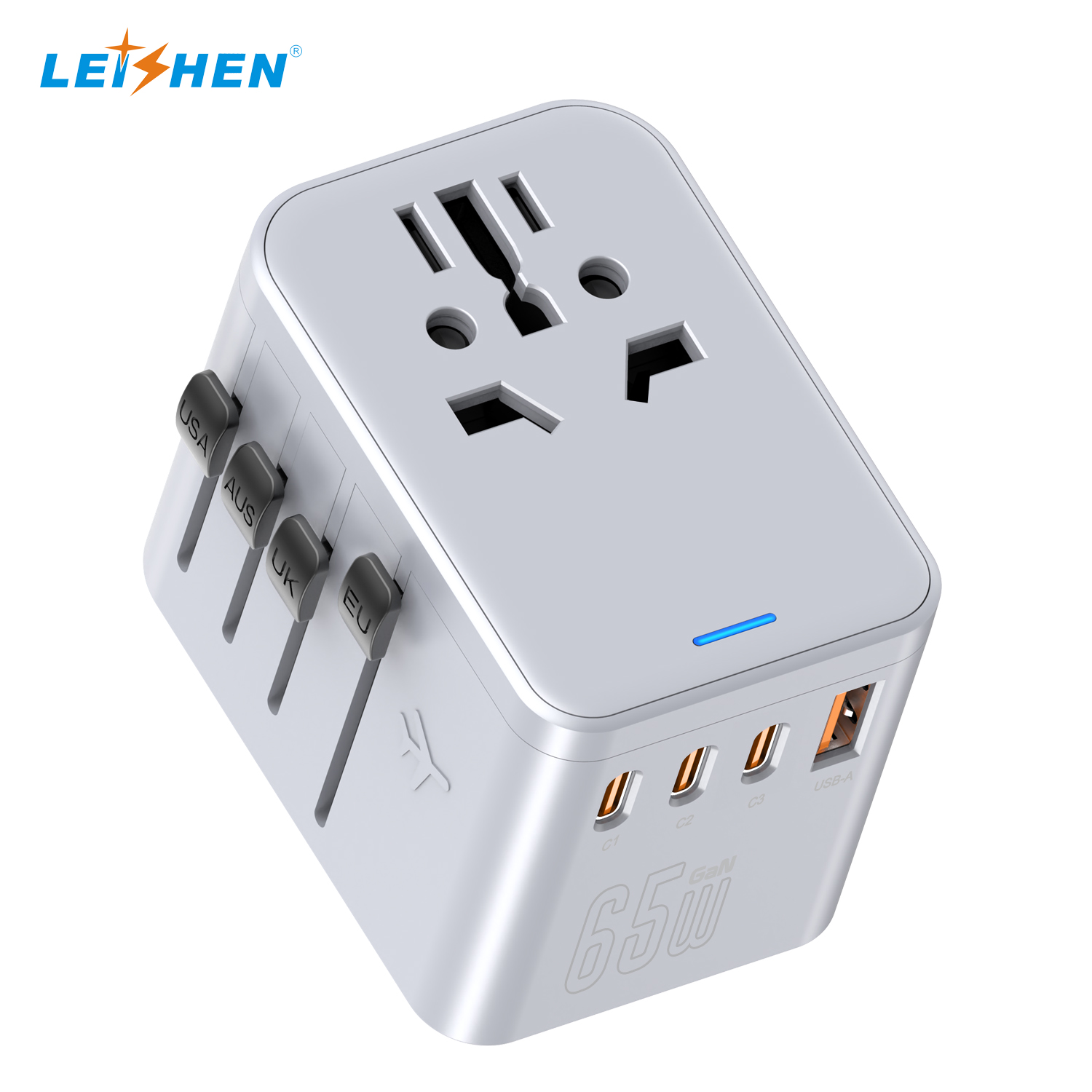
High-wattage consolidation is obsolete in legacy silicon semiconductors, which generate high thermal footprints and suffer significant energy conversion losses. Procurement pipelines are aggressively standardizing on GaN-integrated power circuits ranging from 35W for light consumer travel cubes to 65W–100W for business road-warrior multi-port solutions capable of operating high-draw laptops and smartphones simultaneously. In parallel, the phasing out of discrete AC transformers within hospitality and corporate environments has elevated demand for modular, multi-pin designs featuring smart thermal cutoff relays and self-resetting over-current protections.
GaN Core Miniaturization
Higher thermal conductivity and ultra-efficient switching speeds allow up to 60% reduction in travel adapter enclosure volumes while sustaining high continuous loads (up to 100W PD).
Dynamic Power Distribution
Multi-port USB-C and USB-A smart load balancing chips negotiate dynamic voltage/current contracts (PPS, PD 3.0, QC 4+) to eliminate device overcharging and battery thermal stress.
Eco-Plastics & ESG Criteria
Global retail brands are contractually requiring post-consumer recycled (PCR) polycarbonate casings that meet UL 94 V-0 flame-retardant safety thresholds without harmful halogen additives.
Engineering & Regulatory Evolution of Universal Plug Adapters
How the travel adapter landscape is moving from passive pin-converters to active, high-efficiency intelligent power stations.
The global travel adapter manufacturing sector is undergoing an engineering overhaul. For decades, traditional universal adapters relied solely on simple mechanical spring sliders, often vulnerable to pin wobble, contact fatigue, and loose tolerances that caused high terminal resistance and micro-arcing. Modern industrial solutions utilize single-side mechanical interlock systems that prevent the simultaneous deployment of multiple pins, directly addressing the severe risk of electric shock when an unused live plug contacts human fingers or grounded conductors.
Crucially, CE certification for travel adapters is no longer limited to low-voltage electrical assessments. Compliant hardware must satisfy rigorous electromagnetic compatibility (EMC EN 55032/EN 55035), radio equipment directives where smart IoT microcontrollers are integrated, and Low Voltage Directive (LVD 2014/35/EU). Exporters to the UK must independently ensure compliance with BS 8546, which specifies comprehensive mechanical endurance, fuse integrity (BS 1362), and dimensional precision under extreme temperature stress.
| Feature Parameter | Legacy Passive Adapters | Next-Gen CE Certified GaN Adapters |
|---|---|---|
| Semiconductor Core | Silicon-based MOSFETs (High Heat, Bulky) | Navitas / Innoscience GaNFast Core |
| USB Power Output | 5V/1A to 5V/2.4A (Slow charging) | 20W, 35W, 65W, up to 100W PD 3.0 PPS |
| Safety Interlocks | Manual multi-slide levers (Risk of dual-pin exposure) | Patented Single-Slide Mechanical Lockout |
| Overcurrent Protection | None or manual glass ceramic tube fuse | Auto-Resetting PTC Fuse (6A-10A rated) |
| Enclosure Material | Standard ABS (Flammable above 600°C) | Pure Bayer PC, UL94 V-0 Glow-Wire 850°C |
| Regulatory Standards | Basic unverified CE claims | CE, RoHS, BS 8546, IEC 60884, FCC, UKCA |
Guangzhou Haxli Electric: Certified Manufacturing Excellence
Direct from our 10,000㎡ production base in Guangzhou, delivering verified component engineering and Fortune 500-level quality assurance.
SGS Verified Facility
Onsite verified by SGS international inspectors. We maintain 10+ lean production lines, delivering over $3.8M in verified annual export capacity.
In-House Testing Lab
Equipped with glow wire testers, high-potential dielectric test benches, plug withdrawal force meters, and salt spray corrosion chambers.
Fortune 500 Qualified
Proven track record executing strict supply contracts for Fortune 500 companies with robust AQL 0.4/1.0 acceptance criteria and complete batch traceability.
Agile OEM/ODM Cycles
From custom 3D prototyping and internal PCB routing to custom mold tooling, color matching, and certified packaging in 25–35 days.
B2B Procurement FAQ: CE Certified Travel Adapters
Essential regulatory, technical, and supply chain insights for global procurement specialists and product line managers.
Does a CE mark on a universal travel adapter automatically guarantee entry to all EU member states?
Not inherently. The CE mark signifies compliance with EU directives including the Low Voltage Directive (LVD) and Electromagnetic Compatibility (EMC). However, socket interfaces within the EU are not harmonized by a single universal standard; Germany utilizes Type F Schuko (DIN 49440/441), while France and Belgium strictly enforce Type E (NF C 61-314). Importers must ensure the adapter's grounding pins, collar dimensions, and plug depth mechanically mate with these distinct national standards.
How does an OEM travel adapter prevent dangerous single-pin insertion hazards?
Under IEC 60884 and BS 8546 specifications, adapters must integrate safety shutter systems. Our internal shutters prevent electrical contacts from opening unless dual pins (live and neutral) are inserted simultaneously with equal mechanical pressure. This prevents children or careless users from inserting foreign metal objects or single pins into an energized live terminal.
What is the critical engineering difference between auto-resetting PTC fuses and traditional ceramic fuses?
Traditional ceramic or glass fuses (e.g., BS 1362) blow permanently when a customer connects a high-power device (such as a 2000W hair dryer to a 6A rated adapter), rendering the unit unusable until manually replaced. Our advanced models feature high-grade Polymeric Positive Temperature Coefficient (PTC) self-resetting fuses that isolate circuit flow under overload and automatically restore power once the terminal cools down, drastically reducing end-user return rates.
What testing documentation should B2B buyers request prior to placing production orders?
Buyers should demand a complete third-party test report package rather than just a Certificate of Conformity (CoC). This includes the IEC/EN 62368-1 safety test report for integrated USB electronics, EN 55032/EN 55035 EMC reports, RoHS/REACH material chemical analyses, and Glow-Wire Test certifications (IEC 60695-2-11) verifying that plastic housings do not propagate flames at 750°C–850°C.
Can universal travel adapters convert alternating current (AC) voltage between 110V and 230V?
No. Universal travel adapters mechanically bridge different plug shapes; they do not convert input AC voltage. The AC socket passthrough delivers the local grid voltage directly. However, the integrated USB-A and USB-C GaN power modules accept universal input from 100V to 250V AC at 50/60Hz, safely outputting regulated direct current (DC) for mobile electronics worldwide.
Engineer Your Custom Power Products with Guangzhou Haxli
Consult with our senior electrical engineers to discuss custom tooling, third-party certification testing, and wholesale OEM pricing for your market.
Inquire Now